
Speech Therapy
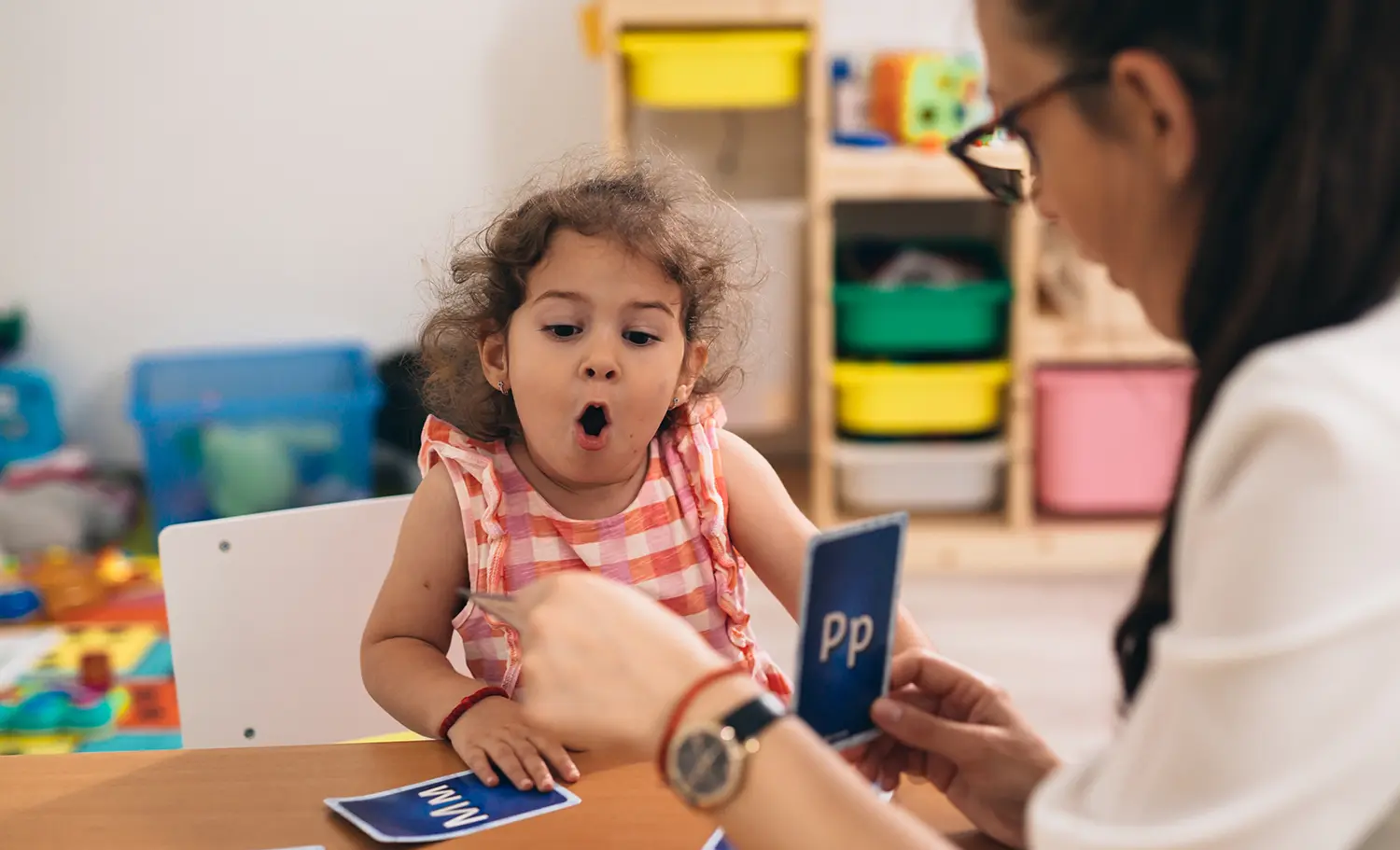

A 2026 study in the Journal of Speech, Language, and Hearing Research, Beyond Toddlerhood, retested former late talkers years later. Of the 36 children researchers could test with confidence, 19 still had a language or literacy disorder. Your two-year-old points, babbles, and understands every word you say, and the words themselves just are not coming. You are already wondering about pediatric therapy in Park Ridge and what an evaluation would show.
People tell you to wait it out, since some children take longer to talk. That reassurance is meant to help. Instead, it leaves you at 11 p.m., unsure whether to start therapy or wait three months.
Your instinct to check is worth trusting, and one evaluation is what settles it.
What Actually Makes a Toddler a “Late Talker”
When your child is a late talker, the pattern can be easy to miss at first. Your child understands what you say and plays the way other children their age do. The only thing lagging is the spoken words.
Broader speech or language delay is different. It affects how much your child understands, or how clearly they pronounce sounds. Late talking describes children from roughly 18 months up, and it no longer applies once your child turns three.
To tell a language delay and a late talker apart, watch closely. What your child understands is your clearest sign. A two-year-old who goes and gets their shoes when you ask, without any pointing or gesturing from you, understands far more than they can say.
Context matters as much as the count. Twelve words is nothing to worry about at 19 months. The same 12 words at 30 months is a reason to call.
Age-by-Age Signs to Watch For
The most useful thing you can do before any therapy visit is count words. Count only the words your child uses on purpose, without any prompting from you. Approximations count, so “ba” for ball belongs on your list.
Words your child only repeats back to you do not count. If you have a late talker at home in Park Ridge, those numbers give the therapist a real place to start.
15 to 18 Months
The revised Centers for Disease Control and Prevention Milestones by 18 Months Checklist expects a child to try three or more words besides “mama” or “dada.” If that doesn’t ring true for your child, here’s what to watch:
- Count the spontaneous words: Write down every word your child says without a prompt over three days.
- Watch the pointing finger: Notice whether your child points to show you something, not only to ask for it.
- Flag any lost words: Tell your pediatrician about any word your child said last month and has stopped saying.
As your child moves toward two, your focus shifts from hearing those first words to counting the number of words.
18 to 24 Months
Speech-language pathologists look more closely when a child has fewer than 20 words at 18 months, or is not pairing two words by 24 months. The Hanen Centre sets the same benchmarks for identifying a late talker. Those first pairings matter more than any single new word: “more milk” is the beginning of grammar, and it is worth celebrating.
If your child is a late talker, you probably noticed how much they understand long before you worried about the words. Your child brings you the right book when you ask, follows what you say, and still says almost nothing.
2 to 3 Years
According to Dayton Children’s Hospital, most children put two words together by age 2 and say 50 or more words by 30 months. By then they also follow a two-step request, such as picking up a ball and bringing it to you, and are understood about half the time. By age 3, that grows to more than 200 words, two- and three-word sentences, and speech a stranger can follow most of the time.
Hold those next to your own child. If your late talker is still mostly using single words at 30 months, a speech therapist can give you a clear answer.
Word count and clarity are two separate things, and it helps to keep them apart. A child can reach that 200-word mark and still be clearer to you than to a stranger. One evaluation shows you whether it is the words, the sounds, or both.
Ruling Autism In or Out: What Your Late Talker’s Social Signs Show
Many parents quietly wonder whether late talking is also a sign of a social delay. On its own, late talking points to speech alone. The broader speech delay toddler Park Ridge parents describe shows up when more than one area feels off.
Most quiet toddlers, including most late talkers, are developing typically in every other way. The clearest signal is less about how many words your child has and more about how your child connects with you.
A developmental milestones guide tells parents to call the doctor if a child loses a skill they once had. A lost skill can be a word your two-year-old used in March and dropped by June. It can also be a gesture, like a wave or a point your child used to give you.
- Shared glance: Notice whether your child looks from a toy up to your face to share the moment with you.
- Growing gestures: Notice whether your child keeps adding new gestures, such as pointing or waving, as the months go by.
- Pretend play: Notice whether your child feeds a doll or makes engine noises pushing a toy car.
If your late talker points to share and plays pretend, those are the social signs a clinician looks for. They point toward speech rather than autism. If you want a fuller answer, your pediatrician can point you toward developmental screening.
Why Early Answers Beat “Wait and See” for a Late Talker in Park Ridge
Most late talkers do catch up, and the American Speech-Language-Hearing Association’s Late Language Emergence portal puts that at 50% to 70% by late preschool and school age. That is real reassurance for most families.
That also means 30% to 50% don’t catch up on their own by then, and many of those children go on to need speech support. At age 7, a language impairment affects 20% of former late talkers and 11% of other children. Waiting turns out fine for most children, and an evaluation is how you learn early which group your child is in.
In Illinois, timing matters. The Illinois Early Intervention Clearinghouse sets eligibility at a 30% delay in one area of development, for children from birth to 36 months. The state funds that support up to your child’s third birthday.
After that, your late talker in Park Ridge qualifies through the local school district. The Illinois State Board of Education’s transition guidance sets the handoff at the day before your child turns three. The district completes its own evaluation before its services begin.
Starting early keeps your options open. You can book a private evaluation for speech therapy in Park Ridge and still use the free state screening. A late talker identified here in Park Ridge at 22 months still has 14 months of funded early intervention ahead.
How to Book a Speech Evaluation at Our Park Ridge Clinic
Three steps get your child from your first phone call to a scheduled evaluation.
- Call the clinic directly: Reach our Park Ridge team at (773) 620-7800 and tell them what you are noticing at home.
- Check your coverage first: Ask our billing team which of your plan’s benefits apply before you book.
- Book the evaluation slot: The time you reserve becomes your child’s recurring session.
Our Park Ridge clinic sees children from 18 months through 18 years, depending on the service. The wait from a first call to a first visit is usually two to four weeks, depending on availability.
You stay in the room the whole time while a certified speech-language pathologist evaluates your child, and you hear the findings in person before you leave. The written report follows within a week and names the goals therapy will start with.
Frequently Asked Questions from Park Ridge Parents of Late Talkers
These ten questions come up most often on calls to our Park Ridge clinic. The answers match what our clinicians say on the phone.
How Do I Know If My Late Talker Needs to See a Speech Therapist in Park Ridge?
Three signs are worth a call to a speech-language pathologist. Look for no true words at 15 months, fewer than 20 words at 18 months, or no two-word pairs at 24 months. Our Park Ridge clinic sees late talkers from 18 months up. Bring the three-day word count you kept at home, since the therapist will start from your number.
How Do I Tell the Difference Between a Late Talker and a Real Speech Delay?
The difference lies in what your child understands rather than in the word count. A late talker follows what you say and plays at age level while saying very little. A child with a broader delay misses some of what you say, or makes sounds a stranger cannot follow. Therapy builds vocabulary for a late talker, and works on understanding or on making sounds for a broader delay.
Is It True That Boys Talk Later, and Could My Late Talker Turn Out Like Einstein?
Family history and being a boy do raise the odds of late talking, but odds only describe a whole group of children. The Einstein story gets repeated often, though biographers disagree on how much of it holds up. Either way, it tells you nothing about your two-year-old’s word count today. An evaluation at 24 months answers the question for your child, not for children in general.
Should I Wait and See If My Late Talker in Park Ridge Catches Up on Their Own?
Some children catch up on their own, and others need extra help. There is no way to know ahead of time, so waiting is a bet. A 2026 study of former late talkers found a language or literacy disorder in 52.8% of the children researchers could test. An evaluation costs one visit to our Park Ridge clinic and gives you a written baseline.
What Are the Red Flags I Shouldn’t Ignore at 18 Months?
At 18 months, these signs are worth a call to your pediatrician. Your child’s three-day word count comes in under 20 spontaneous words. Your child rarely points, waves, or gestures to get your attention. A one-step request such as “give it to me” no longer works unless you point too.
Could My Child’s Late Talking Be a Sign of Autism Instead of a Speech Delay?
By itself, late talking does not point to autism, and most quiet toddlers are not autistic. The Centers for Disease Control and Prevention’s autism prevalence tracking identifies autism in about 1 in 31 children by age 8. The signs that call for a broader look sit in social connection, so screening pays attention to how your child relates to people. A speech evaluation at our clinic covers play and social skills alongside vocabulary.
Should I Get My Toddler’s Hearing Checked If They’re Not Talking?
A hearing check is worth doing for any late talker, even one who seems to hear you perfectly well. Fluid behind the eardrum after repeated ear infections can muffle speech sounds for months, which is often enough to slow word learning. The hearing test takes only a few minutes, and it rules out a cause that is simple to treat.
What Happens During My Late Talker’s Speech Evaluation at CST Academy in Park Ridge?
A certified speech-language pathologist evaluates your late talker in a single session at our Park Ridge clinic. Part of that session is a set of tests that measure what your child understands and the sounds your child can make. The rest is play, so the therapist can see how your child uses words to get what they want. The plan comes together only after both.
How Much Does a Speech Evaluation Cost, and Does CST Academy Take My Insurance?
Our Park Ridge clinic is in-network with Blue Cross Blue Shield PPO, Aetna, and select Blue Cross Blue Shield HMO plans. The self-pay rate is $125 per session for speech therapy, occupational therapy, physical therapy, and feeding therapy. Illinois law requires insurance companies to cover medically necessary speech therapy for children. Your exact benefit still depends on your plan, and our billing team verifies it before you start.
How Do I Get Started with Speech Therapy for My Late Talker?
Fill out our Get Started form or call (773) 620-7800. A late talker can start without a referral and without a diagnosis. The Illinois Department of Early Childhood’s Early Intervention Services page notes that anyone can refer a child under age 3 for a free screening. Many families run the state screening and a private evaluation at the same time.
Take Your Next Step for a Late Talker in Park Ridge
Before you decide what comes next for your late talker, keep these three things in mind:
- The clock is running. Every month before your child’s third birthday is a month Illinois still funds early intervention; the local school district takes over evaluations once that birthday passes.
- Waiting doesn’t give you an answer. Only about half to two-thirds of late talkers catch up on their own, and nothing in the research tells you in advance which will.
- One visit gives you an answer. A single evaluation tells you whether your child needs therapy now or simply more time, instead of leaving you to wonder.
Schedule a free consultation with CST Academy’s team at our Park Ridge clinic. A certified speech-language pathologist will tell you whether your late talker needs an evaluation now or a second look in three months.
The consultation is free, and booking it does not commit you to therapy with us. Either way, you walk out with an answer specific to your child and a clear next step, instead of another night of guessing.
Schedule Your Child's Evaluation Today
"*" indicates required fields
You Might Also Like
Communication is one of the most important skills a child develops. But for some children, speaking verbally is...


Social skills are the building blocks of communication, relationships, and community. For children with autism, developing these skills...

Turn-taking is one of the building blocks of communication. It’s the foundation of every conversation, teaching children how...
Getting Started with CST Academy
Connect with a member of our team for a free consultation.We look forward
to supporting your child's journey!
"*" indicates required fields

Find the Best Care for Your Child

Get Started